
Finding a Way Forward
Although a Parkinson’s diagnosis is something one would prefer to avoid, there are blessings that accompany the hardships. One of those blessings in my own experience has been developing a relationship with the National Institute for Fitness and Sport (NIFS).
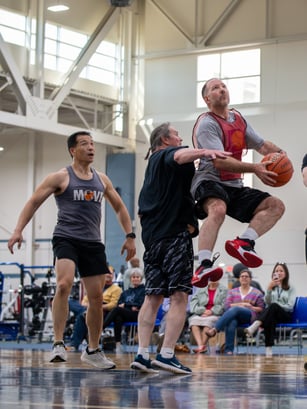
After my 2021 diagnosis at age 50, the one fact I encountered everywhere was that the single best thing for anyone with Parkinson’s is regular exercise — especially vigorous activity. Of course, the best way to stick with exercise is to find something you enjoy. For me, that has always been basketball.
So, in a LinkedIn post, I asked a simple question: Would anyone have interest in developing a basketball-based program for people with Parkinson’s? I tagged several Parkinson’s organizations and professionals. Only one person responded with interest — NIFS President, Emily Davenport.
 From Idea to Action
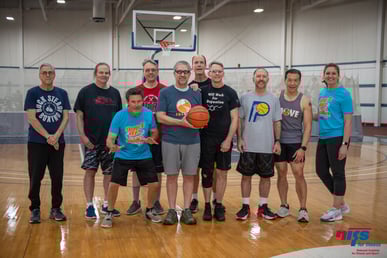
That conversation eventually led to the first annual “Hoop It for Parkinson’s” event hosted by NIFS in April 2025 during Parkinson’s Awareness Month.
The event drew nine players with Parkinson’s — enough for an afternoon of four-on-four, half-court basketball. Most players were from Central Indiana, though two traveled from out of state: Gavin Mogan from Texas and Jimmy Choi, known for his appearances on American Ninja Warrior, from Illinois.
In the months that followed, NIFS continued building on the idea through its Parkinson ’s-focused Bold Moves programming. The team even published a “Basketball for Parkinson’s” handout outlining six basketball-based drills designed to challenge hand-eye coordination, weight shifting, and mobility.
The next “Hoop It for Parkinson’s” event is planned for April 9, 2026. With the support of such energetic and proactive visionaries as Emily Davenport and her colleagues at NIFS, I’m confident basketball-for-Parkinson’s programming will continue to grow. One can even imagine a global network of Parkinson’s hoopsters — similar to the well-known boxing programs that already exist for people with Parkinson’s.
Life on the Court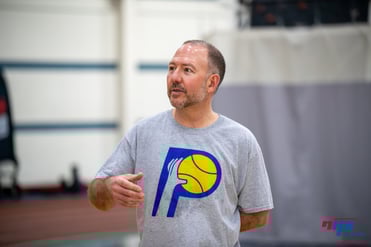
For me personally, basketball remains a regular part of life. I still play several nights a week with a group of players, mostly 40-and-over, and now that group includes several others besides myself who are living with Parkinson’s.
At certain times, I certainly look nothing like a basketball player. Parkinson ’s - induced muscle rigidity can cause a stiff limp, particularly when I’m due for my next dose of medication or after a long day sitting at my desk. Although I’ve largely been spared a tremor so far, my symptoms also include bradykinesia, dyskinesia, and dystonia.
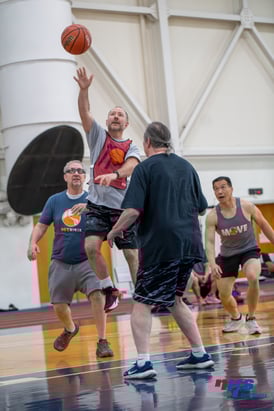
Yet something fascinating happens once I step on the court. Even on days when those symptoms are noticeable, they often seem to fade once I start running and playing. At the very least, I become so immersed in the game that I simply stop noticing them.
 Why It Matters
Parkinson’s is a progressive disorder that generally worsens over time — but that doesn’t mean we are powerless against it. Exercise can play a powerful role in slowing progression and improving quality of life.
Medical journalist Emily Delzell wrote on the Brian Grant Foundation website that the quick, coordinated, whole-body movements required in basketball are exactly the kind of exercise researchers have found to improve Parkinson’s symptoms and stimulate neuroplasticity — the brain’s ability to form new neural connections.
Basketball demands multidirectional movement, coordination between upper and lower limbs, and the ability to stay balanced while in motion. Dribbling, shooting, and jumping build motor skills and create muscle memory that carries over into everyday life.
It also requires something researchers call dual-tasking — thinking about your next move while already in motion and responding to cues from other players. Studies have shown that activities combining physical movement with cognitive engagement can help people with Parkinson’s maintain and improve both motor function and mental sharpness.
The foundation Delzell referenced was created by former NBA player Brian Grant, who was diagnosed with Parkinson’s while still playing professionally. Even after retiring, Grant continued to play recreationally — both for the love of the game and to maintain his health while living with Parkinson’s.
More Than Exercise
Through hard work and dedication, people with Parkinson’s can actually improve their performance in the sports they love. That kind of progress runs counter to the assumption that the only direction for people with Parkinson’s is decline.
Beyond the physical benefits, getting better at a sport after diagnosis can provide a powerful emotional and psychological boost. And that mental side of the battle is just as important.
Whatever a person’s age or skill level, there is something meaningful about stepping on a court with friends and playing the game you love.
That’s a blessing worth appreciating.
Interested in learning more about NIFS Pump It for Parkinson's Event in Indy, or to join us in our nationwide goal of 50 million steps? Click below to see how you can help make an impact on April 9, 2026!
