
<img height="1" width="1" style="display:none" src="https://www.facebook.com/tr?id=424649934352787&amp;ev=PageView&amp;noscript=1">

NIFS Healthy Living Blog

Can You Eat Too Much Protein?

Protein ProductsProtein was once primarily associated with fitness enthusiasts and bodybuilders. It was commonly found in supplements like powders, bars, and shakes. In recent years, however, protein has made its way into mainstream marketing, and now it can be found in nearly everything—from coffee and pasta to popcorn and even soda.

The excitement around protein isn’t unfounded. This macronutrient plays many important roles in the body. Protein helps repair and build muscle tissue, supports immune health, and can help promote feelings of fullness while stabilizing blood sugar levels. However, like most things in nutrition, balance is key. Consuming too much protein may come with some unintended consequences.

First, consuming excess amounts of any macronutrient—whether protein, carbohydrates, or fat—can lead to excessive calorie intake and potential weight gain. Even if total calorie intake stays within recommended ranges, prioritizing protein at the expense of carbohydrates and fats can create a macronutrient imbalance. Carbohydrates and fats serve as the body’s primary and preferred sources of energy, and limiting them too much may leave the body without the fuel it needs.

When adequate carbohydrates and fats are not available for energy, the body may begin converting excess protein into energy. This process produces urea as a byproduct, which must be filtered out by the liver and kidneys. Over time, excessive protein intake can place additional strain on these organs. The body also requires more water to eliminate this waste, which may increase the risk of dehydration if fluid intake is not sufficient.

So how much protein is too much?

While there is a minimum recommended daily intake for protein, there is no universally agreed-upon maximum for healthy individuals. Current dietary guidelines suggest that many adults benefit from consuming about 1.2–1.6 grams of protein per kilogram of body weight per day, depending on activity level and health goals.

For example:

  • A person who weighs 150 pounds (68 kg) may aim for roughly 82–110 grams of protein per day.
  • A person who weighs 200 pounds (90 kg) may aim for roughly 108–144 grams per day.

To maintain balance and allow room for carbohydrates and fats, a common rule of thumb is to keep protein intake at or below about 2 grams per kilogram of body weight per day.

For more individualized recommendations—especially for those with specific health conditions such as kidney or liver disease—consulting with a registered dietitian is the best way to determine appropriate intake levels.

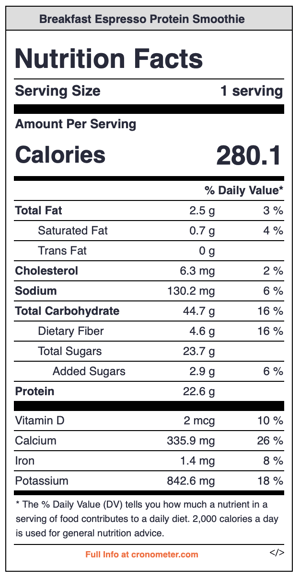
For those looking for a quick and convenient way to support their daily protein needs—especially after exercise—this high-protein shake recipe is an easy option to try:


High Protein Espresso Breakfast Shake

Servings: 2 serving (1 serving = ~10 oz)

Ingredients:

● 1 cup cold brewed coffee

● 1.5 cups fat free or low fat milk

● 1 frozen banana

● ¼ cup raw rolled oats

● 1 scoop vanilla protein powder

● 1 tablespoon cocoa powder

● ½ teaspoon cinnamon

● 1 teaspoon honey

Instructions:

1. Add all ingredients to a blender. Blend for 90-120 seconds until texture is smooth. More milk may be added if the texture is too thick.

2. Enjoy immediately or store covered in the refrigerator for up to 24 hours.

Nutrition Facts:


Topics: nutrition healthy habits protein nutrients

Parkinson’s, Basketball, NIFS, and Me

Bill.Hoop It
Finding a Way Forward

Although a Parkinson’s diagnosis is something one would prefer to avoid, there are blessings that accompany the hardships. One of those blessings in my own experience has been developing a relationship with the National Institute for Fitness and Sport (NIFS).

After my 2021 diagnosis at age 50, the one fact I encountered everywhere was that the single best thing for anyone with Parkinson’s is regular exercise — especially vigorous activity. Of course, the best way to stick with exercise is to find something you enjoy. For me, that has always been basketball.

So, in a LinkedIn post, I asked a simple question: Would anyone have interest in developing a basketball-based program for people with Parkinson’s? I tagged several Parkinson’s organizations and professionals. Only one person responded with interest — NIFS President, Emily Davenport.

D75_3172-Enhanced-NRFrom Idea to Action

That conversation eventually led to the first annual “Hoop It for Parkinson’s” event hosted by NIFS in April 2025 during Parkinson’s Awareness Month.

The event drew nine players with Parkinson’s — enough for an afternoon of four-on-four, half-court basketball. Most players were from Central Indiana, though two traveled from out of state: Gavin Mogan from Texas and Jimmy Choi, known for his appearances on American Ninja Warrior, from Illinois.

In the months that followed, NIFS continued building on the idea through its Parkinson ’s-focused Bold Moves programming. The team even published a “Basketball for Parkinson’s” handout outlining six basketball-based drills designed to challenge hand-eye coordination, weight shifting, and mobility.

The next “Hoop It for Parkinson’s” event is planned for April 9, 2026. With the support of such energetic and proactive visionaries as Emily Davenport and her colleagues at NIFS, I’m confident basketball-for-Parkinson’s programming will continue to grow. One can even imagine a global network of Parkinson’s hoopsters — similar to the well-known boxing programs that already exist for people with Parkinson’s.

Life on the CourtD85_5536-Enhanced-NR

For me personally, basketball remains a regular part of life. I still play several nights a week with a group of players, mostly 40-and-over, and now that group includes several others besides myself who are living with Parkinson’s.

At certain times, I certainly look nothing like a basketball player. Parkinson ’s - induced muscle rigidity can cause a stiff limp, particularly when I’m due for my next dose of medication or after a long day sitting at my desk. Although I’ve largely been spared a tremor so far, my symptoms also include bradykinesia, dyskinesia, and dystonia.

Yet something fascinating happens once I step on the court. Even on days when those symptoms are noticeable, they often seem to fade once I start running and playing. At the very least, I become so immersed in the game that I simply stop noticing them.

D85_5612-Enhanced-NRWhy It Matters

Parkinson’s is a progressive disorder that generally worsens over time — but that doesn’t mean we are powerless against it. Exercise can play a powerful role in slowing progression and improving quality of life.

Medical journalist Emily Delzell wrote on the Brian Grant Foundation website that the quick, coordinated, whole-body movements required in basketball are exactly the kind of exercise researchers have found to improve Parkinson’s symptoms and stimulate neuroplasticity — the brain’s ability to form new neural connections.

Basketball demands multidirectional movement, coordination between upper and lower limbs, and the ability to stay balanced while in motion. Dribbling, shooting, and jumping build motor skills and create muscle memory that carries over into everyday life.

It also requires something researchers call dual-tasking — thinking about your next move while already in motion and responding to cues from other players. Studies have shown that activities combining physical movement with cognitive engagement can help people with Parkinson’s maintain and improve both motor function and mental sharpness.

The foundation Delzell referenced was created by former NBA player Brian Grant, who was diagnosed with Parkinson’s while still playing professionally. Even after retiring, Grant continued to play recreationally — both for the love of the game and to maintain his health while living with Parkinson’s.

More Than Exercise

Through hard work and dedication, people with Parkinson’s can actually improve their performance in the sports they love. That kind of progress runs counter to the assumption that the only direction for people with Parkinson’s is decline.

Beyond the physical benefits, getting better at a sport after diagnosis can provide a powerful emotional and psychological boost. And that mental side of the battle is just as important.

Whatever a person’s age or skill level, there is something meaningful about stepping on a court with friends and playing the game you love.

That’s a blessing worth appreciating.

Interested in learning more about NIFS Pump It for Parkinson's Event in Indy, or to join us in our nationwide goal of 50 million steps? Click below to see how you can help make an impact on April 9, 2026!

Learn More About Pump It For Parkinson's!

Topics: basketball pump it for parkinsons Parkinson's Awareness

Simple Nutrition Habits to Feel Your Best Heading into Spring Break

GettyImages-1960974311Did you know that the average American spends about $4,000–5,000 a year on fast food, dining out, and mobile orders? Now as a student that might be a little less, but if we really break down what fuel we are giving ourselves, it does not always line up with our physical goals or our financial goals. Feeling your best going into spring break usually comes from simple habits rather than drastic changes.

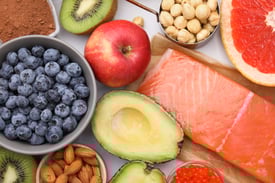
Let us start with consistency: breakfast.

In a semester, assignments are due and projects and exams are always looming over us. It is easy to skip meals and rush to and from classes, sometimes picking up something quick and easy, but is it really fueling us? Foods that contain protein and fiber tend to keep you satisfied and prevent energy crashes later in the day. Holistic foods such as chicken, eggs, beans, oats, and whole grains and 
vegetables tend to make a meal more filling and help the body produce fuel to memorize 
for the exams and keep you going during long study sessions.

Simple Habits That Make Healthy Eating Easier

Some simple tricks and habits that have been shown to improve habits and consistency 
are eating with friends. News flash: eating with friends or coworkers is shown to be 
beneficial. Another habit that has shown itself to be consistent in getting enough fuel for 
the day usually requires more than a quick pick-up order from somewhere. Sitting down 
and either making something from scratch or giving yourself actual time to sit down and 
enjoy your meal, made fresh or not, can make a big difference.

Listen to How Your Body Feels

If finances were not enough to make you take a step back, let us look at how the body feels 
throughout the day. Are we tired, confused, and lazy throughout the day? It might be a 
question about what you are feeding yourself daily. Going into your break you might get the 
opportunity to try mom or dad’s cooking, or even give yourself the time to do something 
and not rush somewhere, but notice your nutrition patterns when you are on break. Does 
your appetite increase or decrease while at home? That could be a big indicator as to what 
you could improve or change when you come back from college.


Eating out necessarily is not a bad thing, but smart financial decisions and making a 
holistic meal, if you have never tried it, might not be the worst thing to try out. Give yourself 
the extra time in the day to experiment with fuel as well. If you do not try breakfast, try it and 
see how much more or less energy you have throughout the day. Follow USDA’s new food 
pyramid and see how it makes the body feel, because I can almost guarantee you that you 
could benefit from at least one thing from it.


The last habit I will give you is to do your own research. There are so many new, interesting, 
and rewarding things you can do to help make yourself feel better. If you spend even a little 
bit of time looking into what foods you are putting into your body, you will find that there are 
always better options. Just as it takes energy for you to do work and school, your body 
needs energy 24/7—even when you are sleeping—to keep things up and running.


Remember, your body is never off the clock. It is constantly changing, improving, and 
protecting itself, so why not give it what it really needs—a good meal.

Topics: healthy habits healthy eating school students

Nine Nutrition Facts You Probably Never Knew

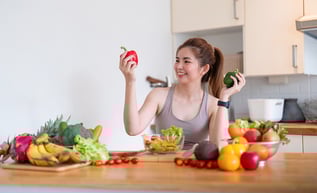
GettyImages-902905486_editedWith March being “National Nutrition Month”, there’s no better time to refresh your nutrition-related knowledge and rethink common food misconceptions and myths. With so much conflicting information online and on food labels themselves due to marketing messages, it can be difficult to separate fact from fiction. Here are nine fun and informative facts that might change the way you look at what’s in your pantry or on your plate:
1. Himalayan pink salt isn’t much healthier than table salt.

While himalayan pink and other sea salts are less processed and may have a higher natural mineral content (iron, copper, etc) than table salt, these minerals are found only in trace amounts and unlikely to provide significant nutritional benefits. Both types of salt are about 98% sodium chloride, however, table salt is often fortified with iodine, an essential mineral needed to produce thyroid hormones. Both types of salts should be used in moderation to reduce the risk of high blood pressure.

2. Blending foods does not remove or reduce their fiber content.

Fiber is found in the flesh, skins and seeds of plant-based foods like fruits, vegetables, whole grains, nuts and seeds. Blending fruits and vegetables into smoothies, sauces and soups is a great way to increase your dietary fiber intake, especially as up to 95% of the population fails to meet the recommended 25-38 grams of dietary fiber/day. As long as everything that goes into the blender is consumed, the fiber content remains the same. In contrast, juicing DOES remove the fiber from fruit, as the juice is separated from the flesh, skins and seeds, which is where the fiber is found!

3. Fruit juice is not always 100% fruit juice.

Fruit juice can be made in two different ways: “not from concentrate” or “from concentrate”. Juice that is not from concentrate is “100% fruit juice” with no added colors, preservatives, or sugars. It is harvested, immediately bottled and stored/sold. Juice that is from concentrate is made from a “syrup-like concentrate” that is made by evaporating water from 100% fruit juice. This concentrate is easy to ship and store, and therefore much cheaper to sell to the consumer, however, due to the loss of nutrients and flavor in removing the water, preservatives and other ingredients are often added, making fruit juice from concentrate an ultraprocessed food and therefore one that should be limited.

GettyImages-1790687703_edited4. Frozen produce can be just as nutritious as fresh produce, if not more.

Frozen fruits and vegetables aren’t just more cost effective - they may also be more nutritious! Fruits and vegetables that are frozen are often picked at peak ripeness, when the flavor is best and often when the nutrient content of foods is at their highest. In contrast, fresh produce is often picked before its peak ripeness to allow for ripening time during transport and storage. Fruits and vegetables that are ripened on the vine often result in higher levels of antioxidants and better flavor. When choosing frozen fruits and vegetables, be sure to opt for those without any added sugars or seasonings, which can make them less nutritious.

5. Peanuts aren’t “nuts”.

Nuts are botanically defined as a dry, single-seeded fruit with a hard shell that doesn’t split open once mature (such as hazelnuts, chestnuts, acorns). By definition, peanuts are actually legumes, plants that produce seeds in pods (such as beans, lentils, peas), although they are legally and culinarily considered nuts. Both nuts and legumes are good sources of fiber, plant-based protein, B-vitamins and many minerals and both food groups should be incorporated several times each week as part of a healthy, balanced diet.

6. Oranges aren’t the food with the highest vitamin C content.

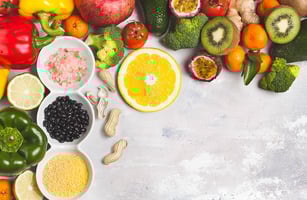
Despite oranges being the face of vitamin C-rich foods, there are many foods that contain more vitamin C per serving than an orange (~70 mg vitamin C per 1 medium orange). For example, one medium red-bell pepper contains ~150 mg vitamin C, one guava contains ~200+ mg vitamin C, and 1 kiwi contains 80-90 mg vitamin C! Vitamin C plays an important role in immune health and function, collagen production, and iron absorption!

7. Pineapple contains an enzyme that helps break down protein-rich foods.

The stem and fruit of the pineapple contains bromelain, a digestive enzyme that helps break down proteins. Some people may experience tingling in their mouth when eating raw pineapple, which is caused by bromelain beginning to break down proteins on the tongue!

8. Eggshell color has no impact on the nutritional value, quality or taste of an egg.

Eggshells come in a variety of colors - white, brown, speckled, blue, green, grey - however, the color of the shell of the egg is determined solely by the breed of the chicken, rather than its nutritional content or quality. Any variation in quality or nutrition would be a result of the hen’s diet or living environment.

9. Multigrain does not mean whole grain or healthier.

100% whole grains are grains in which all 3 layers of the grain are intact, which provide maximum fiber, vitamins and minerals. In contrast, “enriched” or “refined” grains are those in which one or more of the layers of the grain has been removed to allow for consistent color and texture of the product, however, in removing part of the grain, many of the nutrients are also removed. “Multigrain” means that the product uses more than one type of grain, which may or may not be refined or enriched and therefore may not be as healthy. To ensure you’re getting the most nutritious grains, opt for 100% whole grains such as 100% whole wheat bread, quinoa, oatmeal, or brown rice.

Topics: nutrition healthy eating frozen food healthy living