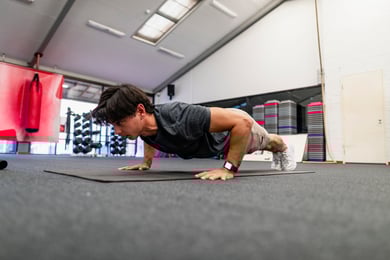
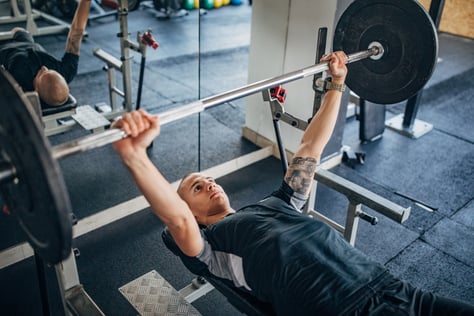
 In a previous blog I discussed the importance of training within the movement categories. Those categories are upper body push and pull, squat, and hinge. To break it down even further within the categories, there are exercises that give you more bang for the buck than others. In this blog I differentiate between compound and isolation exercises. For those of you who are on a time crunch when you are in the gym, these exercises are crucial to get the most out of your training.
What Is the Difference?
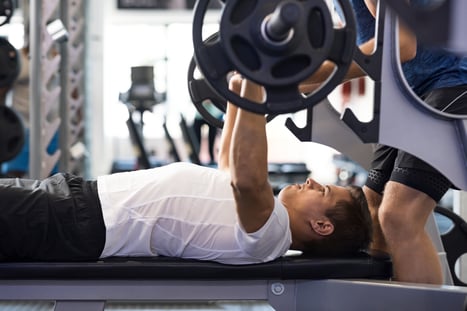
A compound exercise is also known as a multi-joint exercise. This is an exercise in which more than one joint is required to move through the exercise. An example of a compound exercise would be a squat. To complete the squat pattern, three joints must move: the ankle, knee, and hip. Examples of compound exercises for the upper body are the bench press and overhead press. Both movements require the function of the shoulder and elbow. The reason that compound lifts have more payoff is that they work multiple muscle groups as well. A bench press uses the pectoralis muscles, deltoids, and triceps. This requires more energy to be expended than if you used only one of those muscle groups on a single joint exercise. Exercises that isolate a single muscle group are called isolation exercises. Examples of an isolation movement would be a bicep curl, triceps extension, leg extension, or a leg curl. The difference between a compound exercise and an isolation exercise is the number of joints that move.
Which Type of Exercise Should You Do?
Compound lifts are more challenging but less time consuming than performing multiple different isolation exercises. If you short on time while in the gym, a full-body workout full of compound movements will give you the most from your workout. I have written blogs about how to structure those types of workouts. If you want to sculpt your body in a particular way, and are focused on correcting muscle imbalances or injury rehabilitation, each may require the use of specific isolation movements to build up specific muscle groups. So, the question is, what are your goals? Once you define your goals, you can design your workout program.
Structuring a Workout
The most efficient way to structure a workout utilizing both methods is to perform a compound movement first in your workout followed by isolation movements to complement the muscles used in the compound movement. A quick example using the bench press would be bench pressing first, followed by isolation movements to isolate the chest and triceps. You want to save the most amount of energy for your compound exercises, which is why you should perform this one first. Fatiguing the triceps before a heavy bench workout will not yield the best results for bench press. This is why isolation exercises are best performed at the end of your workout.
For more information or guidance on how to structure your workouts, visit our training staff at the track desk in the fitness center. For nonmembers looking for help on your fitness journey, feel free to give us a call to set up a guest fitness assessment.
This blog was written by Evan James, NIFS Exercise Physiologist EP-C, Health Fitness Instructor, and Personal Trainer. To learn more about the NIFS bloggers, click here.
 Olympic weightlifting is one of the oldest sports that is still around to this day in the Olympics. Over time the sport has evolved to what it is today, and there are more participants at the national-level events here in the US than ever before. With the help of
 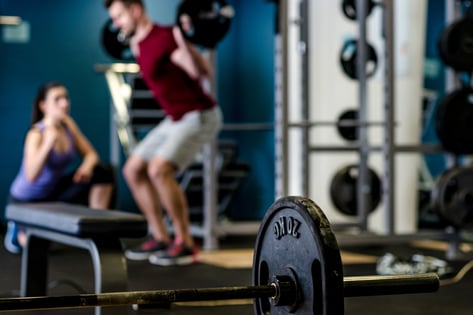 If you are an athlete, powerlifter, or just a person who loves to see progress, you might want to try out cluster set training. This is an advanced type of training designed to get you stronger faster than traditional set training.
  The first thought that comes into most people’s heads when they hear the word weightlifting is, more times than not, “bulky.” The perception is that heavy weightlifting will cause an undesired large gain of muscle mass. This is true; weightlifting will cause you to put on muscle mass, but it will take a lot more than just lifting weights to be “bulky.” Please do not let your goals steer you away from certain exercises.
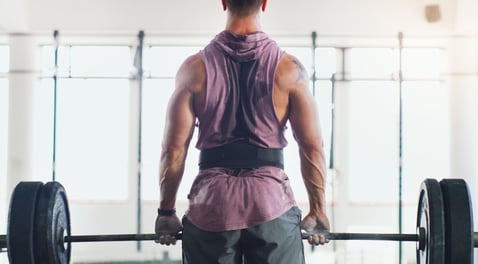 If you are like most people who enjoy lifting weights, you probably have worn a
 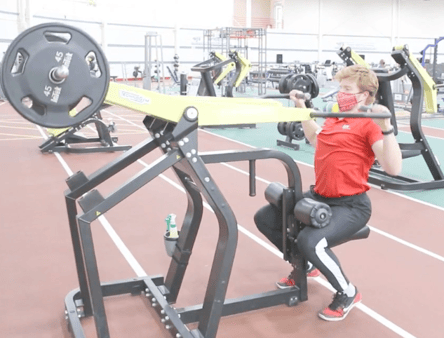 The traditional bodybuilding split of working one muscle group per day might work for the dedicated, high-level competitive bodybuilder who makes their living in the gym. But for the general population only looking to shed some unwanted pounds and improve their overall health, the traditional bodybuilding split is not ideal. Working multiple muscle groups in the same session is much more ideal because it ramps up the body’s metabolism more than working a single muscle group each day. To achieve this, we train the movement, not the muscles.
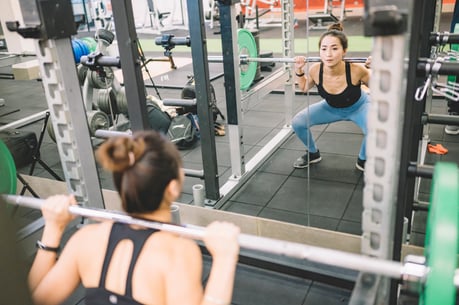 Fall is hands-down one of my favorite times of the year. There’s a crispness in the air, the leaves begin to change, there’s pumpkin-flavored everything, football season is in full swing, and there’s the return of a little phenomenon known as
  Let me ask you a question. Have you ever hit a plateau in the weight room when it comes to increasing strength? What about when it comes to increasing power output (vertical jump, short-distance sprint)? Well if you have, you are not alone. I know I have hit plateaus in the past and it can definitely be frustrating when you are not able to get past it.