<img height="1" width="1" style="display:none" src="https://www.facebook.com/tr?id=424649934352787&amp;ev=PageView&amp;noscript=1">

NIFS Healthy Living Blog

Balance, Stability, and the Foundation of Safe Movement


As it stands with physical activity…

We’ve long supported exercise, and overall physical activity of any form is directly a contributor to better long-term health outcomes and improved holistic wellness. Some studies have shown that irregularities with data indicate that there is a mix of health outcomes regardless of training intensity or modality. We are learning generalized interventions of focusing on increasing the estimated 1-RM for single-leg strength through resistance training and increasing your VO2 Max through aerobics, which are valid concepts. These are excellent interventions to improve quality of life for the long term. However, the “X-Factors” of some data observed also show that there are outliers from the generalization of getting stronger at a leg press, etc. Some people still have diseases, poor health outcomes, and a loss of abilities for ADLs and quality of life, even with a training… Why?

Why are there outliers when we look at how some individuals’ health outcomes may vary regardless of training intensity or modality of exercise?

Physical Activity Frequency and Its Role in Preventive Medicine.
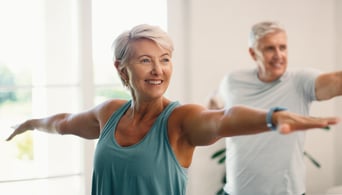
GettyImages-2171685617One important aspect of why this is a phenomenon is how often we move. The amount of movement outside of the gym often correlates to better mobility, better strength, better balance, and one of the most important factors being it is easier to move. If you move often, it becomes a habit to stay in motion and it becomes less demanding as you continue.

From my position as an exercise physiologist, I have worked with clients living with and managing various disease factors. I talk with these populations daily and get a sense of what their lifestyle factors are to gain an understanding of a better approach to their health and wellness holistically. As some studies would indicate, frequency of movement outside of the gym is the most important predictor of long-term health outcomes and a better quality of life. That is why, regardless of increasing single-leg press strength, if we lack the mobility to get up from the ground or walk with a natural gait… it becomes harder to move over time. When this happens, many people move less.

I had a profound conversation with an individual who excelled in their personal wellness journey throughout their Parkinson’s diagnosis. He explained to me a similar thing that I have seen firsthand with many other clients of varying capabilities, limitations, and disease diagnoses. He shared a belief that many people stop moving because they can no longer move in the same way. There is an aversion to physical activity as it becomes more challenging to be active. This is the critical concept we need to emphasize in the fitness industry. The easier we can make movement quality, the more an individual will tend to choose to move. Often, the easier it is to move, the more active an individual will be.

Ease of movement can be affected by cognitive ability, control of the body, balance, mobility, energy systems, and numerous aspects that are all interconnected.

Building Stable and Lasting Movement

Starting with mobility as the basic building block of natural movements and patterns of movement. If we have restrictions in the range of motion and tension around muscles and fascia surrounding those muscles (which occurs as we age and see changes in elastin in our musculoskeletal system), then muscle imbalances become more of an issue. We see compensation no longer move as our structural anatomy might necessitate. Mobility improvement should be an initial focus for movement quality.

Once a level of mobility has been improved, the next focus should be on rebuilding stability with a correct movement pattern. This requires a focus on slow and intentional movement. Studies show that as we speed through an activity, we lose accuracy as a tradeoff. If we are learning a movement pattern that requires intentional focus and muscle engagement, then slower movement develops much more quickly.

The most important recommendation I might make when wanting to develop balance and stability is to focus on the frequency of those movements. The focus should not be on intensity. You might instead plan how often you are performing the movement. We adapt and learn movement patterns largely through our processes of learning, sleeping, and re-learning these movements during the various stages of sleep cycles. That is why when you cram before a test, you perform poorly, whereas if you study often and sleep on it. You connect more long-term information. Input signals and body awareness (proprioception) from feedback traveling from our nerves toward your central nervous system, and the signals going out toward your muscles, etc., to react, are all information that your brain is very clever to recognize and learn.

If your exercises are working on balance or stability, slow it down, progress slowly, and do these exercises regularly. Then these actions and your reactionary control will become second nature… Or the cliché term… “muscle memory.”

What’s next after improving? … Balance, coordination, and stability…

Once movement quality improves to a point that it is good enough to prevent injury and progress, you can then focus on the performance aspect. Performance training can be focused on strength, hypertrophy, etc., but these aspects should not be focused on when we don’t have control and coordination to exercise safely.

Prioritize Safety first, slowing things down as needed, and once you are ready, progress with the performance aspects.

Did You Know?
Exercise is one of the most powerful tools available to help manage Parkinson’s disease. Research shows that regular physical activity—especially exercises that challenge balance, coordination, and mobility—can help slow the progression of symptoms and improve overall quality of life.

At NIFS, we’re committed to raising awareness about the role movement plays in Parkinson’s care. Join us on April 9 for Pump It 2026, a nationwide movement event dedicated to highlighting how exercise supports those living with Parkinson’s while bringing communities together to promote awareness and support ongoing research.

Learn More About Pump It For Parkinson's!

Topics: balance core stability pump it for parkinsons

Parkinson’s, Basketball, NIFS, and Me

Bill.Hoop It
Finding a Way Forward

Although a Parkinson’s diagnosis is something one would prefer to avoid, there are blessings that accompany the hardships. One of those blessings in my own experience has been developing a relationship with the National Institute for Fitness and Sport (NIFS).

After my 2021 diagnosis at age 50, the one fact I encountered everywhere was that the single best thing for anyone with Parkinson’s is regular exercise — especially vigorous activity. Of course, the best way to stick with exercise is to find something you enjoy. For me, that has always been basketball.

So, in a LinkedIn post, I asked a simple question: Would anyone have interest in developing a basketball-based program for people with Parkinson’s? I tagged several Parkinson’s organizations and professionals. Only one person responded with interest — NIFS President, Emily Davenport.

D75_3172-Enhanced-NRFrom Idea to Action

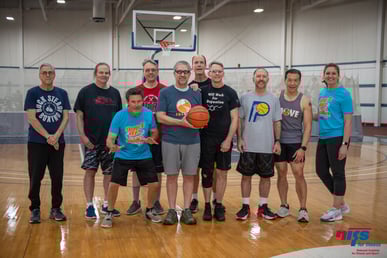
That conversation eventually led to the first annual “Hoop It for Parkinson’s” event hosted by NIFS in April 2025 during Parkinson’s Awareness Month.

The event drew nine players with Parkinson’s — enough for an afternoon of four-on-four, half-court basketball. Most players were from Central Indiana, though two traveled from out of state: Gavin Mogan from Texas and Jimmy Choi, known for his appearances on American Ninja Warrior, from Illinois.

In the months that followed, NIFS continued building on the idea through its Parkinson ’s-focused Bold Moves programming. The team even published a “Basketball for Parkinson’s” handout outlining six basketball-based drills designed to challenge hand-eye coordination, weight shifting, and mobility.

The next “Hoop It for Parkinson’s” event is planned for April 9, 2026. With the support of such energetic and proactive visionaries as Emily Davenport and her colleagues at NIFS, I’m confident basketball-for-Parkinson’s programming will continue to grow. One can even imagine a global network of Parkinson’s hoopsters — similar to the well-known boxing programs that already exist for people with Parkinson’s.

Life on the CourtD85_5536-Enhanced-NR

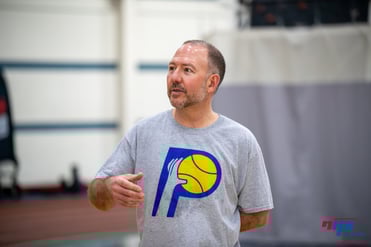
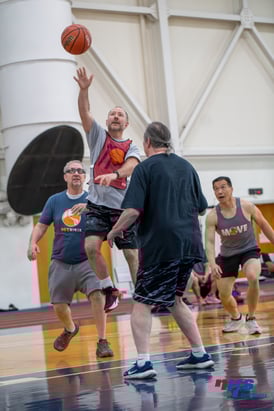
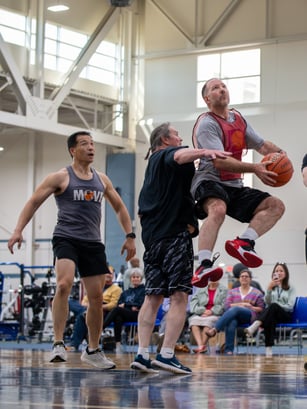
For me personally, basketball remains a regular part of life. I still play several nights a week with a group of players, mostly 40-and-over, and now that group includes several others besides myself who are living with Parkinson’s.

At certain times, I certainly look nothing like a basketball player. Parkinson ’s - induced muscle rigidity can cause a stiff limp, particularly when I’m due for my next dose of medication or after a long day sitting at my desk. Although I’ve largely been spared a tremor so far, my symptoms also include bradykinesia, dyskinesia, and dystonia.

Yet something fascinating happens once I step on the court. Even on days when those symptoms are noticeable, they often seem to fade once I start running and playing. At the very least, I become so immersed in the game that I simply stop noticing them.

D85_5612-Enhanced-NRWhy It Matters

Parkinson’s is a progressive disorder that generally worsens over time — but that doesn’t mean we are powerless against it. Exercise can play a powerful role in slowing progression and improving quality of life.

Medical journalist Emily Delzell wrote on the Brian Grant Foundation website that the quick, coordinated, whole-body movements required in basketball are exactly the kind of exercise researchers have found to improve Parkinson’s symptoms and stimulate neuroplasticity — the brain’s ability to form new neural connections.

Basketball demands multidirectional movement, coordination between upper and lower limbs, and the ability to stay balanced while in motion. Dribbling, shooting, and jumping build motor skills and create muscle memory that carries over into everyday life.

It also requires something researchers call dual-tasking — thinking about your next move while already in motion and responding to cues from other players. Studies have shown that activities combining physical movement with cognitive engagement can help people with Parkinson’s maintain and improve both motor function and mental sharpness.

The foundation Delzell referenced was created by former NBA player Brian Grant, who was diagnosed with Parkinson’s while still playing professionally. Even after retiring, Grant continued to play recreationally — both for the love of the game and to maintain his health while living with Parkinson’s.

More Than Exercise

Through hard work and dedication, people with Parkinson’s can actually improve their performance in the sports they love. That kind of progress runs counter to the assumption that the only direction for people with Parkinson’s is decline.

Beyond the physical benefits, getting better at a sport after diagnosis can provide a powerful emotional and psychological boost. And that mental side of the battle is just as important.

Whatever a person’s age or skill level, there is something meaningful about stepping on a court with friends and playing the game you love.

That’s a blessing worth appreciating.

Interested in learning more about NIFS Pump It for Parkinson's Event in Indy, or to join us in our nationwide goal of 50 million steps? Click below to see how you can help make an impact on April 9, 2026!

Learn More About Pump It For Parkinson's!

Topics: basketball pump it for parkinsons Parkinson's Awareness

NIFS Hoop it for Parkinson’s - we are pumped for this competition!

Hoop it for Parkinsons logoFive years ago, NIFS experienced success with the introduction of our Parkinson’s-based fitness program in the senior living communities we serve across the country. Two years ago, we started hosting an annual event, Pump it for Parkinson’s, to raise awareness on the benefits of exercise for those living with Parkinson’s Disease and the momentum is only growing. The event has provided education to thousands and generated over 22 million steps in 40+ states across the US and Canada and has garnered media attention at our downtown Indianapolis location. The response we have received from people with Parkinson’s, their families, and the communities we serve has been overwhelming in identifying a need. We need to continue the fight to bring the stigma of a Parkinson’s diagnosis out of the shadows and provide quality fitness programs to serve the interests and needs of people with Parkinson’s.

Consider this…

…You are a lifelong exerciser and sport enthusiast, and you receive a diagnosis. You love competition and staying in the game. Does the inner athlete you see in yourself change upon receiving a diagnosis? Do you have the same resources and programs available to stay engaged?

…You don’t exercise, and you receive a diagnosis. You benefit from the structure and guidance of physical therapy, but you are discharged, and your doctor tells you to keep exercising. Do you know how to find a gym? Do the programs and services meet your needs, interest and passions as someone living with Parkinson’s?

With 90,000 people receiving a diagnosis every year in the US, these questions and many others are what people with Parkinson’s face every day along with anxiety for what the future holds. Research indicates that nearly 40% of people experience depression in the year following their diagnosis. Through Pump it for Parkinson’s, we have received countless thanks from people with Parkinson’s and their family for not only raising awareness but celebrating the wins we see people with Parkinson’s achieve when they are exercising. When you focus on the abilities of someone with a new diagnosis, it can help eliminate fear and empower them to pursue lifestyle changes to manage the disease.

NIFS not only has a huge goal of 25 million steps for Pump it for Parkinson’s 2025, but we are also hosting a basketball game at NIFS called Hoop it for Parkinson’s. We have registrants from across the country showing interest in this safe and inclusive environment for halfcourt play while demonstrating to others that the joy of competition has no limits. NIFS partner with Parkinson’s, Bill McCleery shared, “As someone living with Parkinson’s since my 40’s, I appreciate the people at NIFS for embracing the incredible value of exercise and advancing the cause through such great events as Pump it for Parkinson’s and Hoop it for Parkinson’s. I look forward to playing ball at NIFS on April 10!” Our goal is that this inaugural game is only the beginning of bringing additional sports and more friendly competition to the Parkinson’s community. Afterall, Indianapolis is the sporting event powerhouse of the Midwest and NIFS is thrilled to extend that Hoosier hospitality to the PD community.

“You can’t put a limit on anything. The more you dream, the farther you get.” – Michael Phelps

Topics: basketball pump it for parkinsons Parkinson's Awareness