 I have witnessed and been a part of a growing trend in fitness these days: “If it’s not hurting, it’s not working,” and the end of a workout consists of you lying in a pool of sweat unable to move for a few minutes. What I see are mainly poorly coached high-intensity movement jamborees with little concern for proper progressions, obsessions to complete extreme events such as marathons and mud runs, and a great deal of overtraining.
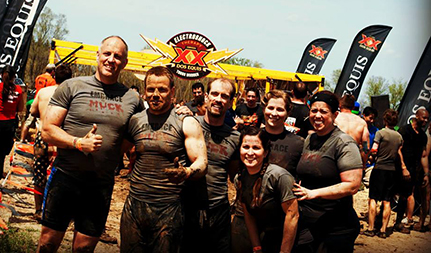
Some mistakes I have made in my own training and the training of others were based on this “it’s not effective if you don’t feel like dying at the end of it” mentality. Having completed two Tough Mudders and a Train Like a Navy Seal program myself, I understand the draw and the fascination with this type of training and events. The mistake is the notion that these are the “standard” by which we measure ourselves when it comes to our physical fitness and capabilities and what our workouts should ultimately look like. I am here to tell you that they are not.
Now, I am not advocating that you should forget about completing that first marathon pr obstacle run, or aspiring to participate in high-intensity training to challenge yourself physically. These are all fine and good, and high-intensity training can be very effective in many aspects of our fitness. What I am advocating is that you be smart about it and take the proper approach and not get caught up with the mainstream idea that this is the standard of health and fitness.
Here are some key steps to ensure that you get the best results from your training, safely. At the end of the day, it should be about getting your desired results and being able to live your daily life.
1. Get Evaluated
Receiving a proper evaluation from a qualified professional before starting any program is paramount. A good evaluation should assess your mobility, stability, relative strength, and cardiac capacity. At NIFS, we use the Functional Movement Screening to help evaluate these aspects and pinpoint any problems you may have first and foremost in your mobility. Without proper mobility, adding load will soon lead to an injury. Knowing your ability to stabilize those mobile joints will provide a focus for the next link in the chain. Having a good grasp on how strong you are with your own body is vital to future strength programming.
Lastly, how healthy are your heart and lungs? A solid evaluation will ensure you do not bite off more than you can chew when beginning your program. Sadly, most people skip this step and their first evaluation is with their doctor diagnosing an injury that occurred during training. Get the movement and fitness evaluation now!
2. Build a Foundation
After gathering that crucial information in the evaluation step, it is now time to build a strong foundation. I am sure you all have heard the story of the Three Little Pigs, so I won’t bore you by reciting it. But the important message there is without a stable and strong foundation, any gust of wind will knock you over, so to speak. Attempting high-intensity, power-based movements on a weak foundation will certainly cause the house to crumble. Adding a positive to a negative will not produce positive results (another Gray Cook truism); it will only continue to train the dysfunctional movement pattern and weaken the foundation. After you find those limitations, take the time to fix them and beef up your foundation on which to build.
3. Master Your Body
A rather frustrating trend I see a great deal is attempting advanced exercises (whether it is barbells, kettlebells, or dumbbells, to name a few) before mastering basic body-weight movements. You learned to crawl before you learned to walk, right? So why would you do heavy bench press if you cannot complete a proper push-up? I think it is drilled into our heads that the best way to look cool on YouTube or Facebook is to load the barbell up with some bumper plates (because they look bigger) and bang out a few crappy reps of a barbell squat. Utilize the best equipment that you have at your disposal, all the time, YOUR BODY! Mastering basic body-weight movements such as the push-up, squat, pull-up, and lunge will set you up properly to attempt more advanced exercises while decreasing your chance for injury. By the way, some of the most effective work I do with people does not involve any additional tools, just the most important one, themselves.
4. Follow a Progressive Program
After completing the above steps, you will know the best place to start and where eventually you would like to finish. Following a fitness program that gradually increases technical needs and intensity will allow you grow the strength and skill to take on more advanced and intense workouts and events. This program really needs to be developed specifically for you, and following a program of someone else will not elicit the same results. To get stronger, you have to start where you are capable of completing the exercise with proper technique and then gradually and systematically increase the load. That’s how it works, that’s it. You will not jump onto a bench press and bang out a world-record lift without the proper progressions. Same thing goes for all aspects of fitness.
So if that is the case (and trust me, it is), why do we think it is okay to hop right into a high-intensity workout or event that we have not yet prepared for by following proper progressions? Even worse, we wonder why we get hurt or don’t see the results we were promised by the very motivated and sweaty individual on TV. You can’t be the best at something right now. It takes methodical and progressive steps, and failure, to get there. A very important part of your progressive program is recovery. Overtraining is a huge problem these days, and I think it is simply due to the lack of knowledge that recovery equals training. The benefits of your work happen during recovery, and not necessarily during training. Keep your eyes open for an upcoming post centered around this important and sometimes neglected concept of recovery in fitness and training.
I’ll be the first to admit my mistakes and that I was “that guy” in the past. “Show up and throw up” was the motto, and anything less than that was a failure. Due to that mentality, I am not ashamed to say that I am still dealing with injuries today from that time in my training journey, and it has definitely affected my training and daily life. John Maxwell once said that “a man must be big enough to admit his mistakes, smart enough to profit from them, and strong enough to correct them,” and I believe I have.
Don’t do what many people do: do the above steps in reverse order. If you have, be big enough to admit the mistake and correct it. Be smart about your training, and don’t get caught up in the hype of what some camps believe fitness and physical activity should look like. Gray Cook put it best when he said, “More is not better; better is better.” Be better!
This blog was written by Tony Maloney, Health Fitness Specialist and Fitness Center Manager. To find out more about the NIFS bloggers, click here.

 I think most of us can agree that a little muscle soreness after a fantastic workout is a fun way to remember that things are changing and that we are getting stronger. I think we can also agree (and most have experienced it) that there is a certain degree of soreness that kind of feels like “everything hurts so badly you can’t stand up or lift your arms,” which isn’t quite as motivating. Along with this you may feel irritable, fatigued, and really hungry. Sounds fun, right?
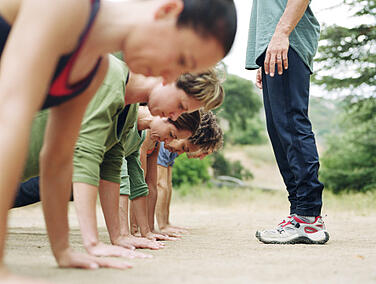 There is a fitness trend that has been bothering me for a long time, and in recent years it has gotten exponentially worse. There are exercise programs that have actually declared war on the human body, and by doing so, have widened the gap further between health and fitness.
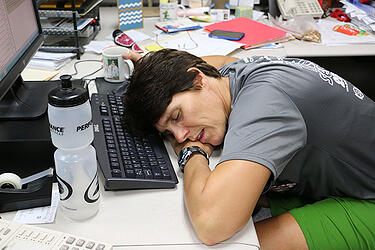 Are you having one of those days (or weeks, or months) where you feel like the gerbil on the wheel? You are going along just fine, and then a stressful situation crops up and you to need to spin the wheel faster. Soon, that’s not fast enough. When you finally realize you are going to be thrown off the wheel if you stop, it hits you: you’re exhausted. I get this way every few months.
 Three blind men, who had been blind for life and who had never experienced an elephant, were brought into an area where an elephant was standing. They were placed within arm’s reach of the animal and were allowed to explore the elephant by just touching what was within their reach. They were not allowed to step closer or move side to side.
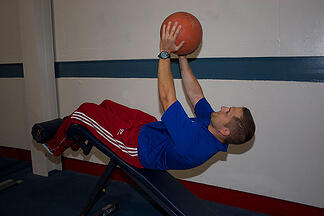
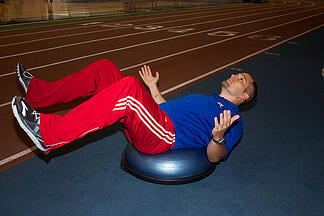

 Over the past decade, there has been an increase in the popularity of barefoot training or training in a minimalist shoe such as a
 Runners are generally good at doing the same thing over and over again, day in and day out: RUNNING! Oftentimes they will neglect doing some of the components of what runners refer to as “the little things” that pay huge dividends in overall performance and how you feel while running. The little things include sleeping enough, eating right, staying hydrated, maintaining flexibility, and core strength, and the list goes on. When there is limited time in the day to get in a quality run, the thought of cutting a run one or two miles short to do core and flexibility work is often quickly neglected.