<img height="1" width="1" style="display:none" src="https://www.facebook.com/tr?id=424649934352787&amp;ev=PageView&amp;noscript=1">

NIFS Healthy Living Blog

Top 10 Must-Have Pantry Items for Healthy Eating

I get asked all the time, “What should I eat?” This is not an easy question to answer. There are foods that should definitely be eaten more often than others, and foods that are better to just have every once in a while, but it’s hard to pick certain foods that are a MUST HAVE in your diet for best nutrition. However, if you are looking for a list of items that you can purchase to have in your pantry for quick, healthy, and easy meal or snack ideas, start with this list.

ThinkstockPhotos-493279620n.jpg
  • Pouches or cans of tuna: This shelf-stable protein source is packed with heart-healthy omega-3 fatty acids. It is also an inexpensive protein, which is nice since meat adds the most to your grocery bill. Add it to salads, or mix with plain Greek yogurt and enjoy a tasty tuna salad. White albacore tuna is the best, but any variety that is water packed is a great choice.
  • Canned beans: These protein- and fiber-filled gems are also very inexpensive. All varieties are great and can easily be tossed into pastas, salads, or salsas for a filling meal or snack. Be sure to drain and rinse them to rid the beans of the high sodium liquid.
  • Extra-virgin olive oil: A staple of the heart-healthy Mediterranean diet, this flavor-packed oil is versatile; you can use it to cook meats and veggies, or drizzle it on a salad for a quick homemade dressing.
  • Oats: Breakfast is the most important meal of the day, and with oats you can start your day in a variety of ways! Add fruit, nuts, nut butters, pumpkin, or flax for a different bowl of goodness each day. These are also good to use in meatloaf or other recipes that call for breadcrumbs, to up the fiber amount.
  • Nuts: Nuts are loaded with fiber and protein (three times more than potato chips!). These should be a regular part of your diet. Whether you love cashews, almonds, pistachios, or another nut, grab an unsalted or lightly salted variety to get the benefits of the good-for-you fat in all nuts.
  • Quinoa/brown rice/whole-wheat pasta: To fill 25% of your plate with whole grains, it’s a good idea to keep some high-fiber options stocked in the pantry. One-half to 1 cup (cooked) of any of these grains will add staying power and tastiness to any meal.
  • Sweet potatoes: Want an alternative to a white potato? Sweet potatoes are loaded with fiber and vitamin A. Since they are naturally flavorful, they won’t need much added to them. Baked, roasted, or spiralized into noodles, a sweet potato is a great addition to any meal.
  • Salsa: A dip that is also a veggie is a must to keep in your pantry. Choose a chunky salsa where the majority of ingredients are just veggies and not a lot of additives. Then use this to top baked potatoes or eggs, or as a dip for veggies. Chips aren’t the only way to get salsa in your diet!
  • Nut butters: Another inexpensive but great protein option is nut butters. You can do the traditional peanut butter, or try new varieties like almond-nut butter or soy-nut butter. All are perfect for adding to whole-wheat toast, oatmeal, celery, or smoothies.
  • Green tea bags: If you need something more flavorful than just water to drink, add some green tea to your routine. It is loaded with antioxidants to keep you healthy, is a great way to get in your fluid intake, is naturally very low in caffeine, and has been shown to speed up your metabolism! All of these are great reasons to reach for this beverage any time of day.

***

What did you eat today? Don’t underestimate the role that proper nutrition plays in your health and fitness. Contact Angie Scheetz ascheetz@nifs.org or click below to learn more about the My Nutrition Coach app. 

 Learn More


This blog was written by Angie Scheetz, RD, Wellness Coordinator. To find out more about the NIFS bloggers, click here.
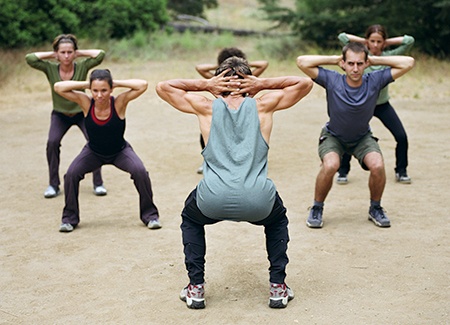
Topics: nutrition healthy eating protein fiber pantry

Are You Glute-n Free? The Importance of Exercises for Glutes

Gluten intolerance and celiac recently has become a very popular nutritional topic. Gluten is a protein found in grains, including wheat and rye. Digestive issues, joint pain, and headaches are a few of the health issues that may occur if you have this intolerance and eat foods that contain gluten. Many individuals adopt a gluten-free lifestyle, which could lead to positive changes when paired with exercise and overall health.

But what if I told you there was a certain lifestyle that would have an opposite effect on your life? This is also characterized as gluten-free, but has nothing to do with food. This “Glute-n Free” lifestyle may be holding you back from achieving many exercise or physical activity goals, or could lead to simple lifestyle issues, such as dealing with nagging lower back pain.

Gluten = Bad, Glutes = Good!ThinkstockPhotos-200069245-001new-1.jpg

This Glute-n free trend I’m referring to is minimal or absence of gluteal exercises during your workout programs. The gluteus maximus is the largest muscle in the body. It is essential in just about every physical activity and is the central core muscle. You could consider this muscle to be the body’s powerhouse. Along with glute max, you have other gluteal muscles with various responsibilities, like hip stability. You will use these muscles in just about every activity that you do. From swinging a golf club to picking up a box off the ground, the glutes are vital.

Glute strength is important no matter what at point you are in your life. You could be an elite athlete looking to improve your broad jump, or a grandparent wanting to be able to pick up your grandchild while playing. Regardless of your goal, the strength of these muscles should be a main focus in your training program. One of the main movement patterns that these muscles help produce is known as the “hip hinge” movement pattern. Some fitness examples of this movement include the kettlebell swing, deadlift, and RDL.

Success in these exercises, or this movement pattern in general, relies heavily on your body’s ability to maintain good form under load, which is much easier when the muscles are up for the task. If muscles do not have the capabilities to withstand these forces, many issues could arise, commonly in the form of lower back pain.

The Functional Importance of the Glutes

This example does not stop in the gym, either. If you are at home and try to pick up a couch while rearranging furniture, the same rules apply. If your body (a big part of which being the glutes) is not strong enough to deadlift the couch, how did you get it up in the air? The simplest answer is that you were able to compensate from some other area (lower back) to hoist the couch up and move it. If strength levels were adequate to lift it, my guess would be you would not be feeling any pain.

On the opposite end of the spectrum, you could be a Division I linebacker who is looking to become more powerful while tackling. Tackling requires an enormous amount of power from the hip hinge position that allows one to deliver the biggest strike possible to the ball carrier. If I told you I would make you a stronger tackle with a few modifications to a training program, would you do it? I’d hope so. 

Top 5 Glute ExercisesGlute-n Free

So now that I’ve given my spiel about why training the glutes is important, here are my top 5 glute exercises that will help you develop a backside that Sir Mix-a-Lot would be proud of. These exercises start with the most basic and end with the most advanced.

  • Single-Leg Glute Bridge
  • Lateral Band Walks
  • Cable Pull-Through
  • Barbell Hip Press
  • Deadlift


This blog was written by Alex Soller, NIFS Athletic Performance Coach. To find out more about the NIFS bloggers click here.


Like what you've just read? Click here to subscribe to our blog!.

Topics: functional training muscles weightlifting stretching exercises glutes

How Stress Affects the Body and Your Health

GettyImages-1222164264_low resThere are so many things in life that can affect different aspects of the human body, and stress is one of the biggest! During a stressful time in life, the body can undergo several physiological changes that can be detrimental to your overall health. Though sometimes we cannot avoid certain stressors that fall into our path of life, there are some things that can be done to help you cope during those times.

What Stress Can Do to You

Let’s take a look first at how stress affects the body.

  • Sleep: Stress disturbs sleep routines, typically making it hard to fall asleep as the mind wanders, tossing and turning, and constant interrupted rest.
  • Upset stomach: Another effect is having a constant feeling of being queasy or nervous.
  • Loss of appetite: Along with having an upset stomach, loss of appetite comes with either consistent or high levels of stress.
  • Rash: Stress can cause hives, which are a type of skin rash. Be sure during stressful times to take care of your skin by washing and moisturizing.
  • Change in eye pressure: When under high amounts of stress, the pressure of your eyes can change, causing something called ocular hypertension, which affects your vision.
  • Increase in blood pressure: Whether it’s short-term or long-term stress, spikes in your blood pressure can be detrimental to your overall heart health.
  • Increase in resting heart rate: The number of times your heart beats per minute can increase with stress levels and cause your heart to work harder than it normally would.
  • Weight loss: Excessive weight loss can come with stress as your body loses its desire to eat.
  • Chronic headaches: Anxiety and stress can increase the amount of headaches you get, as well as the intensity.
  • Back pain: Each person holds stress in their body in different places, oftentimes residing in the back and neck muscles, making it painful to move.
  • Sweating: Stress triggers sweat glands to become more active, causing you to break out in cold sweats (like you are nervous).
  • Tremors: Sudden twitches or tremors can be caused by stress, resulting in the contraction or continuous spasm of the muscles.
  • Bowel issues: One way or the other, bowel issues can happen when under stress.

Overcoming Stress

Now, I know that sometimes stress is out of our control, but when those times come there is something we can do about it. Exercise is one of the proven ways to keep stress levels low. If you are feeling stressed out, try coming to the gym or fitness center to workout, run or walk, do yoga, or whatever you like to do to help you decompress. 

Like what you've just read? Click here to subscribe to our blog!

This blog was written by Amanda Bireline, HFS. To find out more about the NIFS bloggers, click here.

Topics: exercise fitness center stress yoga running walking health sleep rest mindset

Allison Griner: A Complete Life Change Thanks to Weight Loss and NIFS!

allison.jpgIn October 2014, Allison Griner decided to join Weight Watchers through her work. Her reasoning was quite simple: “They were giving a discount through my job.” That day she weighed in at 301 pounds. It wasn’t long before Allison started seeing some results and realized that exercise needed to be a part of the plan as well, so she decided to sign up for an event to keep her motivated. The first thing that came across her radar was the Fight for Air Climb, and in preparation for it she signed up for the boot camp at NIFS.

Now for anyone who doesn’t know what the FFA climb is all about, I’ll just say it’s probably one of the hardest events you could sign up for! The climb is a race up the 49 flights of stairs in the Chase Tower in downtown Indy. And if that doesn’t sound hard enough, the boot camp at NIFS is not the easiest of tasks, either! But Allison completed the boot camp amid the severe challenges of not being able to do a burpee or climb the stairs in the workouts.

It’s been over a year now that Allison has kept to her weight loss journey. She consistently follows a workout schedule, meeting her cousin at the gym, and watches what she is eating; and she combines both cardio and strength training workouts to meet her goals. Allison also has PCOS. PCOS (Polycystic Ovary Syndrome) makes losing weight a very difficult task and is linked to an increased risk for insulin resistance, type 2 diabetes, high cholesterol, high blood pressure, and heart disease. Allison has spent lots of time learning to eat right and to focus on making sure that her perspective is not on how her condition inhibits her losing weight, but rather taking the stance of, “It’s not that I can’t lose weight, I just remind myself it’s easier for me to gain weight.” Despite the odds that are against Allison, she has lost 75 pounds since October 2014!!*

Here are a few things that Allison had to say about her journey:

What has kept you consistent in making a change?

I am a very goal-oriented person, and when I see success it makes me want to keep pushing to the next level. I keep setting milestones, and once I got the eating part under control I knew that adding exercise and staying consistent with that would keep me reaching those.

What things have kept you going?

People in my life are what has kept me going! My mom, my roommate, my friends, and other family have really supported me and helped me to believe in myself. Even in times when I start to feel down, they push me to keep going. There are times that I have hit a plateau and they keep encouraging me to keep it up!

What are your secrets to success?

I forgive myself a lot. If I get down or make a mistake I forgive myself, pick up where I am, and move on. I tell myself it’s a new day and I am going to do better than I did yesterday. I am constantly trying to look forward and not backward, which I think is the key.

How has NIFS helped you to achieve your goals?

This facility is fantastic! There are so many different things to do that I never get bored. There are tons of options with weight lifting, the versatility with the track, the canal, or a treadmill. It’s impossible to not get a good workout. FFA also helped me in the beginning to realize it will take hard work, but that I am capable of doing anything I put my mind to!

What has been the hardest part of this weight-loss journey?

The hardest part is that this is a mental thing. I am always struggling to not see myself as that 300-pound girl. I am not surprised by what people say or what I see in the mirror and how much weight I have lost, because the challenge is looking in the same mirror and seeing myself as not just the big girl that I was. It’s also a struggle if I slip up and eat something I shouldn’t. I have to overcome that mentally and remind myself there will be setbacks and I will make mistakes.

What has been the biggest reward from all your hard work?

I feel better!! I was having chronic back problems when I was at my heaviest weight, and those have been nearly eliminated! The best reward is definitely how I feel.*

Anything else you want to share?

When I was at my biggest weight I always felt like I was in the way. I was never able to go out and do things with friends; my biggest fear was being in a crowd and being in the way. I would get so nervous about the idea of having to maneuver through a crowd of people. If you think that way, you can do something about it! One of the biggest changes I and others have seen through this time is my social life. I am confident to go out and be myself now!

*Weight loss claims and/or individual results vary and are not guaranteed.

Congratulations Allison on all your hard work and success! We know this journey has not been easy and it’s not over yet, but we encourage you to keep going and sharing your inspirational story!

***

Like what you've just read? Click here to subscribe to our blog!

This blog was written by Amanda Bireline, Fitness Center Manager. To find out more about the NIFS bloggers, click here.

Topics: NIFS cardio nutrition motivation weight loss attitude boot camp strength stairs

Adding Nutritional Supplements to Your Diet and Workout

Most of us have specific goals in mind when it comes to an exercise program. We work hard to achieve these results day in and day out, but sometimes our bodies may need an extra push to get over that hump. Many people question the importance of adding supplements to a healthy diet and workout routine, as well they should.

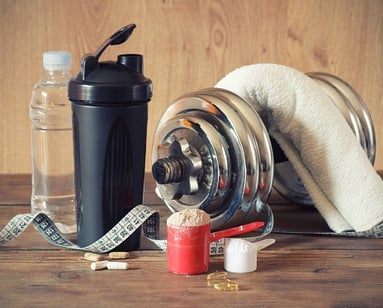
ThinkstockPhotos-471775270.jpgWith so many different supplements flooding the shelves these days, it’s hard to know which ones will truly help you achieve your desired results. Although I agree that some supplements might not be necessary to include in your program, others could be beneficial to many individuals no matter what their fitness goals are.

Not a Substitute for Proper Nutrition

Before I go any further, I want to note that supplementation is simply an addition to your diet and exercise regime. These are not meant to replace a well-balanced whole-food diet; they are meant to be used in conjunction.

Most of the nutrients we need are already being produced by our own bodies to a certain extent, as well as existing in foods we eat daily. Some essential nutrients such as protein, creatine, and branched-chain amino acids (BCAAs) are naturally produced in the body and can be found in meat products, including (but not limited to) red meat, fish, and ground turkey. These amounts are just large enough to support daily functioning, but may not be produced in large enough quantities to aid in dramatic physique enhancements. If you are looking to take your physique to the next level, supplementation might be just what you need.

Which Ones Should I Use?

Here are the top five supplements (in my opinion, and that of many top professionals) you could add to your exercise and diet program.

  1. Branched-chain amino acids (BCAAs): BCAAs are essential nutrients that help the body slow down protein and muscle breakdown, which can aid in preventing muscle fatigue during intense workouts. It works by stimulating the building of protein in muscles, which in turn helps prevent muscle breakdown. I would not recommend using BCAAs when trying to gain muscle hypertrophy (or size), as muscle breakdown is essential for muscle growth. Instead, try a pre-workout or caffeinated drink before your workout for extra energy.
  2. Creatine: Creatine is an organic acid that is produced in the liver and helps supply energy to cells all over the body (especially muscle cells). People take creatine because it allows the body to produce more energy, and with more energy a person is able to increase the intensity of their workouts. Many athletes use creatine to improve their overall performance. It also helps aid in quicker muscle recovery after an intense workout.
  3. Protein: Your muscles need protein grow and recover from muscle breakdown caused by exercise. You can get plenty of protein in your diet; however protein shakes are generally lower in calories than a high-protein meal. They are also portable and more convenient that carrying around whole-food meals (here are some ideas for making your own). Two widely used proteins are whey and casein. Whey is a fast-digesting protein that aids in muscle recovery and muscle growth. Casein is a slow-digesting protein that creates a longer-lasting supply of muscle-building nutrients. Many experts recommend taking a mixture of the two proteins to ensure a release of amino acids into the blood for as long as possible, therefore aiding in lean muscle gain as well as body fat decline.
  4. Multi-vitamins: Multi-vitamins are essential to support the body’s everyday functioning. Your body needs a variety of complex nutrients for optimum efficiency and performance. Taking a high-potency multi-vitamin can ensure your body is getting those essential nutrients to support thousands of metabolic reactions. Here’s more information on the importance of a multi-vitamin for your health and fitness goals, including a list of the essential vitamins and minerals you need.
  5. Fish oil: Fish oil tablets are the most efficient way to get the purest and most concentrated dose of Omega-3s into your diet. Omega-3s have been proven to improve blood circulation, which in turn will allow nutrients such as protein and carbohydrates to reach muscles. Omega-3s also help with maximizing metabolic rate, which in turn helps with fat loss.

Dietary supplements can have many health benefits as well as many performance-based benefits. If you are not concerned with taking supplements for their potential performance enhancements, you should at least be taking supplements such as multi-vitamins and fish oil tablets for your general health. They can be an easy addition to your diet and exercise regimen that may have huge effects on your overall health. Add supplements on an as-needed basis after conducting a needs analysis, and implement one at a time.

If you have additional questions or concerns about supplementation, please stop by and ask any Health Fitness Specialist at NIFS or contact our Registered Dietitian, Angie Mitchell for more information.

Like what you've just read? Click here to subscribe to our blog!

This blog was written by Darius Felix, Health Fitness Specialist at NIFS. To find out more about the NIFS bloggers, click here.

Topics: fitness nutrition fitness center protein muscle mass vitamins supplements

USDA Guidelines: Making the Nutrition Recommendations Work

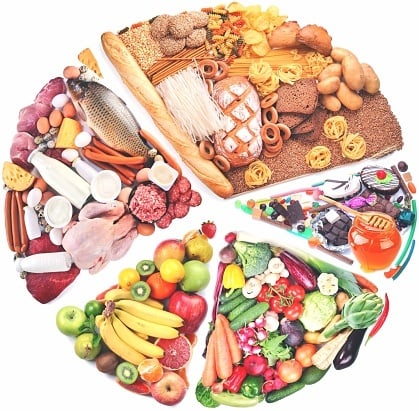
ThinkstockPhotos-501294518.jpgEvery five years, the USDA releases new Dietary Guidelines for Americans. Typically people get their idea of what healthy eating is and what they should be doing from all kinds of sources. Maybe it’s from a magazine, a TV news report, something a friend or family member suggested, or from reading blogs. Wherever you get your information, know that a team of researchers put together the most recent scientific evidence to come up with their recommendations for Americans. Here’s what they found, with some of the most important takeaway tips.

Strive for a Balance Over Your Lifespan

The current guidelines shift away from recommending foods you should or shouldn’t eat, and instead emphasize the importance of a balanced overall eating pattern. Here are the specific recommendations:

  • Follow a healthy eating pattern across the lifespan. Eating patterns are the combination of foods and drinks that a person eats over time.
  • Focus on variety, nutrient-dense foods, and amount.
  • Limit calories from added sugars and saturated fats, and reduce sodium intake.
  • Shift to healthier food and beverage choices.
  • Support healthy eating patterns for all.

Watch Sugar, Fat, and Sodium Intake

The new guidelines also put a cap on sugar, saturated fat, and sodium that can lead to heart disease and obesity, and are easy to overeat. The limits are as follow:

  • Less than 10% of calories per day from added sugars.
  • Less than 10% of calories per day from saturated fats.
  • Less than 2,300 milligrams (mg) per day of sodium for those over age 14.

A couple issues that have arisen after the release of the most recent guidelines is the lack of straightforward numbers for sugar and saturated fat. For example, most people are not aware what 10% of their calories would be from sugar and saturated fat (most sources from sugar are in sodas and juice drinks, and saturated fat is from red meat). Instead, an easier recommendation for the public to follow would be to drink more water instead of sugary drinks, and to eat vegetarian meals two to three times per week instead of red meat.

Moderation Is Key

Overall the new Dietary Guidelines for Americans are a helpful tool in reinforcing what we already know: a balanced diet with all of the food groups in moderation is the best one to follow.

If you need help planning your meals or knowing what to eat, consider a personal nutrition coaching session with our Resident Nutritionist, Lindsey Recker by email or by phone at 317.274.3432
ext 239.

Learn More

This blog was written by Angie Scheetz, RD, Wellness Coordinator. To find out more about the NIFS bloggers, click here.
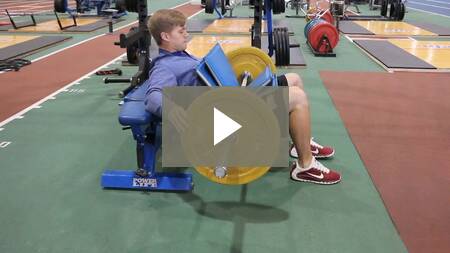
Topics: nutrition calories hydration sodium sugar

Effective Grip Strength Training Solutions

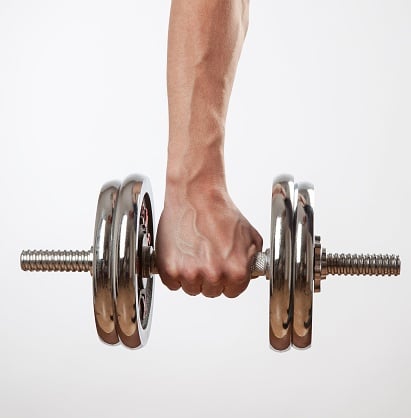
ThinkstockPhotos-472123412.jpgGrip strength is quite a conundrum in the fitness industry. It is so often called upon during training, yet grip-strength training itself can be overlooked.

Many people don’t even think to train grip strength, or they don’t think that grip training will benefit them. Have you ever had trouble opening a jar or a can? Have you ever dropped a bag of groceries while trying to carry in every single bag from your car (like I do every Saturday)? Now do you think grip training might benefit you?

How Can a Better Grip Help You?

Any activity that involves holding something is going to require grip strength to some degree. Here are a few activities that may or may not come to mind when you think grip strength.

  • Golfing: When playing golf, every shot you take requires you to hold a club. When holding the club, it pays to have a tight grip. Why? When you hit the ball, there is a transfer of energy from your hands to the club, and from the club to the ball. To get all of the energy from your hands to the club and the ball, you need to allow for as little movement of the club as possible when striking the ball. Grip strength is required to minimize the movement of the club upon striking the ball.
  • Carrying a suitcase: Whenever you carry anything, you need grip strength. This usually isn’t a concern when the item you are carrying is light, such as a book or a cup. However, an item like a jam-packed suitcase can really test your grip when you are running through the airport to catch your plane. And if you work grip strength exercises into your workout routine, you can catch that plane and make it to family Christmas on time!
  • Picking up a heavy object: This one seems like common sense, right? That’s because it is. When lifting a heavy object, such as a piece of furniture, grip strength is what keeps that object from crashing to the ground. You may have very strong legs, arms, and back, but if your grip is too weak to hold the object, you can’t move it!
Training Your Grip

So how can you train your grip to be stronger and have more endurance? There are many different ways, and here are a few (for more exercises, see this article):

  • Using a thicker bar: A larger object is harder to hold onto than a smaller object. Therefore, a thicker barbell will be harder to hold onto than a thinner barbell. You can incorporate a thicker bar into your normal weightlifting routine by substituting it into every exercise you would normally do with a regular bar. Don’t have access to a thick bar? You can create a thicker bar. All you need is a couple of towels. Just wrap them around the bar to the thickness you desire, and you’re ready to go! (CAUTION: Be careful and use a spotter when weightlifting. A new technique means you will need to take time to get used to it.)
  • Plate pinches and flips: If you’re lucky, your gym will have bumper weight plates (and yes, we have plenty here at the NIFS Fitness Center!). These work great for either plate pinches or flips. In a plate pinch, you pick up a bumper plate between your thumb and your other four fingers, and you either stand still to go for time, or you can walk with them and try to go for distance. In a plate flip, you grip the plate in the same way as you would for a pinch, and you do a half flip, catching the side of the plate that was just facing the ground. (Again, use caution when doing these exercises. These plates can be heavy, and if the exercise is done incorrectly, somebody could get hurt.)
  • Dead hangs: For this, all you need is a pull-up bar. From a pull-up position, just hang freely from the bar for as long as you can. This will test your grip strength endurance, which is very functional for things like carries and holds.
Grip strength has been a crucial part of my recent training. I like lifting heavy weights, so it was frustrating for me when my grip strength was my limiting factor on lifts such as the deadlift. I have incorporated a few of these techniques, and after a couple months I saw progress. Weights that used to slip from my hands felt much more manageable in several different lifts that involved gripping and pulling. If you don’t believe me, try these for yourself! Give it a little bit of time; soon enough, your grip will be stronger and your days of struggling to open that pickle jar will be over.

***

This blog was written by Aaron Combs, NSCA CSCS and Health/Fitness Instructor. To find out more about the NIFS bloggers, click here.

Topics: NIFS fitness center weightlifting exercises golf grip strength grip

Why I Have a Passion for PiYo Fitness

piyo.jpgOkay, so you may have been hearing the word “PiYo®” circulating these last few months within the world of group fitness. For those of you who feel like you do not completely know what it means or what the class entails, fear not. I guarantee you are not the only one with questions, and as a certified PiYo instructor, I would love to share a few reasons why I teach it, and the benefits that can come from practicing it.

PiYo® is a Beachbody program created by celebrity fitness trainer Chalene Johnson (who is also the creator of TurboFire, Turbo Kick, etc.). She originally created the PiYo® class because she wanted a workout that would provide results without straining your body. She loved the benefits of Pilates and yoga but got bored with the static moves in yoga and the microscopic movements in Pilates. So essentially, the class is set to music, combining moves from both techniques and making them dynamic to give participants an enjoyable yet challenging class that works on not only body strength, but also balance and flexibility. Let’s look a little more deeply into those features.

Bodyweight Strength

PiYo_LOGO_Gray_M.jpgSurprisingly, for many of us (myself included), just using our own bodyweight for certain exercises can be challenging enough. From moves like triceps pushups, to lunges, to side planks, 140+ pounds begins to feel really heavy really quick! PiYo® takes many of these simple-to-learn yet challenging moves and combines them with aspects such as “time under tension” and dynamic pulses to keep the body moving the whole time.

Each song also has its own focus; the workout begins with a heat-building track to wake up the body and get blood flowing to the muscles, then moves into a lower-body and power track. Following those, we seamlessly transition the second half of the class into a yoga flow, and finish with a core and stretching/strength track to leave you feeling worked and refreshed.

Balance

I want to take this opportunity to emphasize that balance does matter! It’s amazing how quickly we lose balance over time if we do not continue to develop it. Think about how many times you shift your weight from one side to the other; from simply walking, to going up and down flights of stairs, to catching yourself when you trip, to leaning backward or forward to grab something off the floor. For the younger generation it might seem quite simple, but I promise you, in 30 years, if you never trained in a split stance or single-leg pattern, just standing on one leg for 30 seconds can turn into one of the most difficult and frustrating things you have done.

Flexibility

As a former dancer, this aspect is one of my personal favorites. If you want to deepen your flexibility in your hips and hamstrings, and focus on finding space within those areas to stretch, PiYo® is wonderful for this, especially the flow section, which focuses on this. Even if you have never been very flexible, and simply just want to work on being comfortable when you reach to tie your shoes, or being able to twist and open the t-spine to improve your posture, PiYo® has something to offer for that as well. Mobility work is so important in performance, as we age, and is essential to maintaining and improving quality of life.

***

If you are wondering whether you could keep up in a PiYo® class or if you could do it, you can! The best part of PiYo® is that it’s your workout! I run the class and have the moves and choreography, but it’s your workout and you are more than welcome to take it at your own pace. That includes modifications; I make sure to offer plenty of modifications to assist and advance you as you go along, allowing you to have a suitable class that will not only challenge you, but also be safe for you to participate in. Take a look at NIFS group fitness schedule and:

Try a group fitness class for free

This blog was written by Rebecca Newbrough, Lifestyle Program Coordinator and Health Fitness Instructor. To find out more about the NIFS bloggers, click here.

Topics: fitness yoga balance Pilates stretching core strength bodyweight Beachbody

Five Powerlifting Pieces to the Power Clean Puzzle

Olympic (Oly, ah-LEE) and powerlifting have become increasingly popular over recent years and will continue to grow, considering their application to functional training and athletic movement.

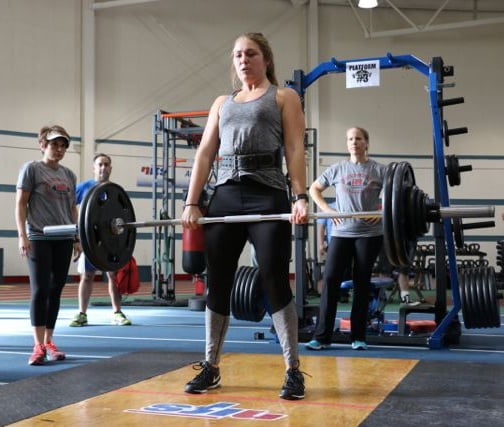
deadlift-2new.jpgWhether you have particpated in our Powerlifting Competition or interested in joining,  I’m going to give you a solid progression that will allow you to develop a strong power clean with proper technique. The following movements can be a starting point for beginners or experienced lifters looking to get a fresh perspective on their current programs.
When I venture into any Olympic or powerlifting movements with a client or athlete, the most important factor is that their body be able to perform the movement that I am asking them to do. I get a good idea of this by using the Functional Movement Screening (FMS) and a few lower-intensity exercises (kettlebell swing, goblet squat, ground-based plyometrics, etc.) that utilize similar movement patterns to those that the Oly or powerlifts entail. If an individual is not able to perform these movements correctly or their FMS score contraindicates their participation in them, I would focus on other areas in order to better prepare that individual for these lifts. Once I believe someone is fully capable of performing the lifts (in this case with regard to the power clean progression), I could start them on the progression.

1. The Deadlift 

The first (and arguably most important, in my opinion) step in this progression would be to teach proper hip-hinge technique for a deadlift. This is the foundation of the majority of the Oly movements and needs to be perfected in order to reach the fullest potential in subsequent lifts. Learning this movement could take as little as a couple weeks, but will likely take more like 4 to 6 weeks depending on your current abilities. Take your time; it will be worth it!

Points of Emphasis:

  1. Keep your back flat.
  2. Keep the bar close to your body.
  3. Use a Hook or Pronated grip (which has a better translation to Olympic movements).
  4. Start by pulling slowly from the ground; velocity will be added later.
Recommended training time frame: 4 to 6 weeks (depending on ability level)

2. The Power Shrug

Once you have perfected the deadlift, you can implement the next movement. From the deadlift position, I usually transition to a power shrug. The power shrug is just what it sounds like, a shrug with more speed than normal. The power shrug allows for the client or athlete to feel what it is like to achieve triple extension after the deadlift. It begins with a deadlift to an RDL position (with the bar at or just below the knees). Once the RDL position is achieved, the hips are driven through to generate the upward momentum to the bar. The client simultaneously shrugs his or her shoulders toward their ears to finish the movement.

Steps to Achieve:

  1. Start with a deadlift to the RDL position.
  2. Once the RDL position is met, drive the hips through.
  3. Finish with shoulders shrugged toward the ears and on the tiptoes.
Recommended training time frame: 3 to 4 weeks

3.The Hang Pull

The next step in my progression would be to go into a hang pull. This movement is more of a “top-down” movement versus a “bottoms-up” movement when compared to the deadlift and the power shrug. The deadlift and power shrug start from the ground and move upward from there. In contrast, the hang pull starts from a standing straight up position. The ultimate goal for all of the movements will be to get to the powerful RDL position. The hang pull involves lowering the bar to the knees and then driving the hips through to generate an explosive upright rowing motion. You may integrate the shrug that you have learned in progression #2 in order to produce more of that upward drive. The movement finishes with the client coming down from their toes after the pulling motion.

Steps to Achieve:

  1. Stand up straight.
  2. Lower the bar down the legs in a hip-hinge motion.
  3. Once RDL is achieved, drive the hips through, shrug, and row.
  4. Finish on tiptoes.
Recommended training time frame: 2 to 3 weeks

4. The Hang Clean

Now the fun begins. Through the first three steps you’ve learned to properly hip hinge and how to achieve triple extension through the hips, knees, and ankles. You’ve learned to shrug and pull from steps 2 and 3. If done properly, step 4 (the Hang Clean) should be a piece of cake. The hang clean builds off of the hang pull by adding the firing of the elbows under and through the bar to achieve a front rack position with the barbell positioned across the shoulders. If you have been diligent through steps 1 to 3, this should not be an issue. The biggest problem I see with individuals in this stage would be a lack of mobility through the wrists, triceps, and shoulders. Timing is everything with these lifts, so once you know you are doing them correctly, practice, practice, practice. The less your mind has to think about any part of this movement, the more success you will see.

Steps to Achieve:

  1. Perform steps 1 to 4 for the Hang Pull.
  2. Slightly sink the hips.
  3. Pull and fire the elbows under the bar.
  4. Finish with the bar racked across the shoulders.
Recommended training time frame: 4 to 6 weeks

5. The Power Clean

You have made it this far; it’s time to seal the deal! The final progression for the power clean would be, well, the power clean. During this progression, your job will be to assemble all of the pieces of the power clean puzzle from steps 1 to 5. This movement will start with the deadlift to the RDL position, continue with a big shrug and pull, fire the elbows, and sink beneath the bar. It is essentially step #4, but we are pulling from the floor.

Sounds simple, right? Not exactly. This will introduce a whole separate challenge with regard to timing, but as always, your timing will get better with practice. Once you feel comfortable pulling from the ground and catching the bar in the upright/hips loaded position, catching into a front squat will be next (but you should perfect this first).

Steps to Achieve:

  1. Deadlift to RDL position.
  2. Drive hips through.
  3. Shrug shoulders and pull upward: get triple extension!
  4. Sink and fire elbows beneath the bar.
  5. Catch and rack the bar across the shoulders.
Recommended training time frame: 4 to 6 weeks

***

Olympic and powerlifting movements are definitely the king of the fitness world jungle. They should be done with extreme attention to detail due to the high velocities of the bars (Oly lifting) and extreme weights being used (powerlifting). That doesn’t mean you need to be a fitness expert to perform them; just learn how to do them correctly. Although these pieces to the power clean puzzle lead you in the right direction, it is always beneficial to have another set of eyes on you to make sure that everything is in working order. Realize that it takes a while for your body to adapt and grasp these movement concepts, especially if you are new to this type of lifting. Remember, be patient and a stickler on details; it will pay off in the long run!

***

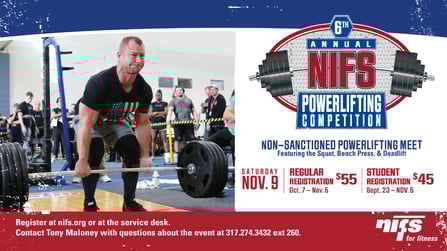
NIFS 6th annual Powerlifting competition is coming in November. For more information and to get registered click here. Early Bird pricing is $45 until October 6th.

Screen Shot 2019-09-25 at 9.30.23 AM
This blog was written by Alex Soller, NIFS Athletic Performance Coach. To find out more about the NIFS bloggers click here.

Like what you've just read? Click here to subscribe to our blog!

Topics: NIFS group training NIFS programs weight lifting powerlifting functional movement assessments

NIFS Crucial Conversations: I Took My Life Back (Part I)

Katie_Before_2.jpgThere comes a time when a story of struggle, strife, and success must be shared to remind others that you are never alone in your battle, and that achievement and happiness are closer than you may think. Katie Feltman has such a story.

I have had the privilege to work with Katie for many years now, and I can remember the first conversation we had out in the fitness center about where she was at the time, where she wanted to go, and how we could work together to get there. I felt her struggle instantly, but I also felt a great deal of determination, evident from the progress she had made before coming to see me. She wasn’t going to take this battle lying down anymore!

I asked Katie to talk about her journey with me so that I could share it with those who may be looking for that spark, that notion that nothing is impossible, but I’Mpossible! Join me in walking in Katie’s shoes as she shares some of her journey with us.

Conversation with Katie, Part I:

Tony: So, take me back about four years and tell me what was going on with you at that time.

Katie: I was living a very different life. A recent doctor’s visit had revealed I weighed 286 pounds, I was pre-diabetic, I had high blood pressure, my LDL cholesterol was high, and I had just found out I had to wear a Holter monitor to diagnose heart arrhythmias I was having. I had lower back pain from herniated discs that required an unhealthy amount of daily Advil to keep at bay (and along with my poor eating habits had created a wicked case of acid reflux that ultimately became an ulcer) and I slept poorly. For 37 years of age, I wasn’t doing okay. I was unhappy.

Tony: What were some of the major struggles you were dealing with?

Katie: Like most people, I had my share of stress sources; nothing extreme or unusual, but I had an ill mother, and a job that looking back now I realized had reached a point that made me miserable. But generally I had nothing going on outside of me that should have triggered the kind of profound lack of self-care I was engaging in on a regular basis.

“I coped with my stress by pushing my feelings inward and washing it all down with sugary processed foods and wine. I made no time to take care of myself.”

Katie_Before_4.jpgYou’d think with the scary words the doctor was saying I would have walked out of there that day and taken charge of things right then. But change isn’t like that—not for me, at least. I was frustrated with how I felt, and I know this will sound superficial but it is true: I hated how I looked, which I didn’t realize then but now know was key to my struggle. Self-hate = no self care, and that was how I was living my life. I was living life in a muted capacity, and I lacked the motivation to do something about it—any of it.

Tony: Can you describe some of what you were feeling at that time?

Katie: I was demoralized and frustrated at what seemed like an impossible and insurmountable task—it was so daunting. Getting healthy, changing how I lived, and peeling pounds off. I wanted instant results from modest change. I’m an extrovert, and my social life at the time revolved heavily around eating out, going to bars, and generally going places where food and booze were the main reasons for being there multiple times per week. But there was a nagging voice in there that knew there was more out there for me—I just wanted to feel better, feel happy most of the time, cope better with the smaller, mundane stresses as well as major things, and sleep better.

Tony: How did these struggles and frustrations affect your life? What did you feel like before you decided to take your life back?

Katie: I felt unhappy, ashamed, and not in control of my own life, and generally was in a terrible place emotionally and physically. And if it hasn’t been stated clearly enough before, I felt like crap pretty much all the time and it wasn’t just physical—it was mental, too. I was in a fog much of the time. I didn’t handle even small stresses well, much less bigger things. I was just floating along with life rather than living the life I really wanted to live.

“I was just floating along with life rather than living the life I really wanted to live.”

READ PART 2 of this amazing story and learn what it took for Katie to make the critical changes that resulted in her being able to take her life back and overcome obesity and a lack of healthy habits and see measurable weight loss.*

*Weight loss claims and/or individual results vary and are not guaranteed.

This blog was written by Tony Maloney, ACSM Certified Exercise Physiologist and Fitness Center Manager. To find out more about the NIFS bloggers, click here.

***

Getting started is the hardest part...Let us help! Sign up for a free Fitness Assessment today!

Free Fitness Assessment


Topics: NIFS healthy habits fitness center weight loss attitude diabetes personal training heart disease Crucial Conversations obesity making changes